


It’s the first Open Mic Night of the new year at Tia Chucha’s, Centro Cultural and Bookstore. I wander in to a spare crowd that gradually fills the seats in time for the feature presenter, Teresa Mei Chuc.
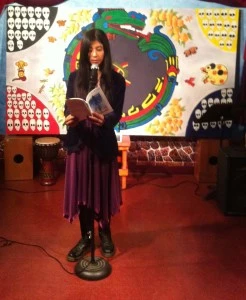
Teresa, reading at Tia Chucha’s Open Mic
“I try not to breathe in the spirits…” she shares, writing of a visit to Con Son Island where prisoners were tortured during the Vietnam War.
“…but I breathe in
the smoke of incense.
A bat flutters by
A green grasshopper lands by my foot
Someone is saying hello
Perhaps it is a girl who died in a Tiger Cage”
The poem, “Praying at the Cemetery on Con Son Island,” is from a soon to be released chapbook, titled: How One Loses Notes and Sounds, forthcoming from Word Palace Press.
Teresa, an accomplished author with two full-length collections of poetry and numerous publications in chapbooks, anthologies and journals, was born in Saigon. She immigrated to the U.S. under political asylum at the age of two, after the Vietnam War. Much of her poetry is a personal journey of understanding, a sharing of comfortless truths.
I am mesmerized by a gentle voice penetrating the room, drifting through the soul like incense. Quiet descends, a heavy pressure to resist the applause each poem earns. I am not the only person who aches with a need to honor her haunting echoes of mourning. I find myself agreeing “…there are not enough incense sticks for all the graves on Con Son Island.”

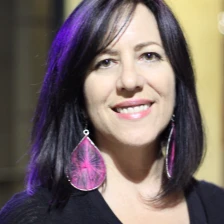
Photo by Judith Foster (at a photo shoot for my poetry book)
In the poem, “Sonnet of the Syrian Boat Refugee,” Teresa’s own experiences bring us into the boats of our contemporaries. I hear horror dipped in elegance as she ends with:
“I have now passed through nature’s severe tests
Yet, I stand still before this ghostly fence.”
It’s the poem, “Quan Âm on a Dragon” that chills my ghostly senses, and I realize the depth that pervades this poet. She tells us about her mother’s conviction that she saw a bodhisattva in the clouds as they fled Vietnam on a freight boat with 2,450 refugees. She shares her desire to overcome disbelief:
“But, a part of me wants to believe in a bodhisattva, in compassion
riding on a mythical creature, to believe that somehow something
more than just our mere humans selves wanted us to live.”
Through her use of poetry and story, Teresa is the quintessential example of compassion overcoming trauma. The sentiments of tragedy are drawn with humble images, simple language adorned in grace. Despite the horrors of humanity’s story, she reminds us that kindness is life’s best weapon.
Ghazal : Kindness
(While living in Israel…Old Jerusalem, 1994)
The weapon we have left is our kindness.
In the Middle East, my heart felt kindness.
I learned to write the Arabic letters.
From right to left, my hand curved in kindness.
I was a teen and learned to say the words
“salam,” “kayf halik,” “shukran” in kindness.
Arabic tea in Old Jerusalem,
I tasted mint in hot liquid kindness.
I wandered around the Muslim quarter
and saw a camel sitting in kindness.
The golden sun rose upon ancient stones
in the Old City that needed kindness.
To learn more about Teresa Mei Chuc, order How One Loses Notes and Sounds, or view her events calendar, visit Teresa’s website: http://www.tue-wai.com/


[…] it’s in great part due to my “fairy godmother,” Teresa Mei Chuc who organized the inclusion of many poets through her C2P2 Coast to Coast Poetry Press Collective. […]